
Shadow IT has changed. It’s no longer just a matter of unauthorized software installed outside the IT department’s perimeter. In 2026, the nature of the risk has changed: it’s called Shadow AI, and it’s no longer just stealing control, it’s absorbing your know-how.
Every day, dozens of employees enter confidential data into ChatGPT, Gemini or Copilot with no defined usage policy, no traceability and no governance. The result: a silent and irreversible leakage of intellectual property to third-party infrastructures, often outside Europe.
Faced with this reality, there’s only one effective response: not banning, but governing.
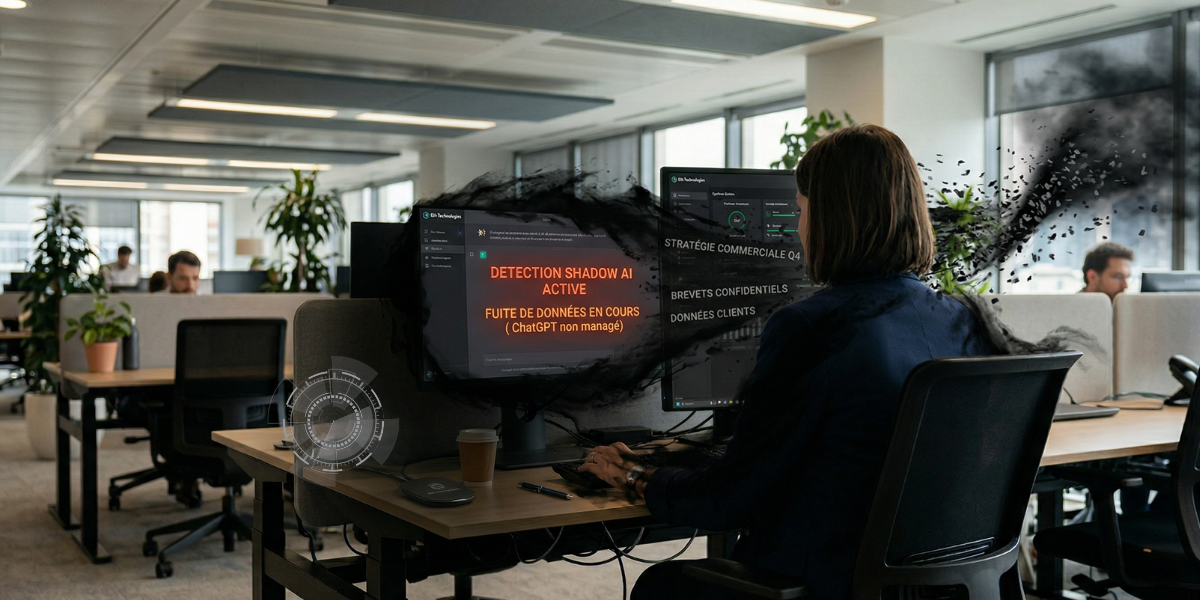
Shadow AI: when risk changes dimension
Yesterday’s Shadow IT moved data to unauthorized storage. Today’s Shadow AI offers it for third-party training.
This is a fundamental difference. A file stored on a personal Dropbox remains recoverable. A prompt containing a sales strategy, a contract under negotiation or sensitive HR data, sent to an unmanaged public model, potentially becomes a permanent contribution to the knowledge base of a competitor or foreign player.
Productivity takes precedence over safety. 59% of employees use AI tools not approved by their company, and this figure rises to 93% among senior executives and managers (Cybernews, 2025). Prohibition doesn’t work: it pushes usage into the shadows.
The cost of a violation is documented. According to the IBM Cost of a Data Breach 2025 report, 20% of organizations have already experienced a data breach related to Shadow AI, adding an average of $200,000 to the cost of an incident. Prevention is no longer optional.
The exposure perimeter is invisible. AI agents don’t just pass through browsers. Chrome extensions, stealth APIs integrated into business tools, meeting bots that transcribe and analyze in real time: the attack surface is diffuse and underestimated.
IA Act 2026: from constraint to strategic opportunity
Prohibited practices and the requirement for teams to maintain control over AI (Article 4 of EU Regulation 2024/1689) have been in effect since February 2025, transparency requirements have been in effect since August 2026, and the high-risk regime has been postponed to December 2, 2027. This postponement is a window of opportunity to prepare, not a reprieve: we detail what remains applicable in “Postponement of the AI Act: Requirements That Remain Applicable in 2026.”
In any case, the first step is the same: find out what AI applications are actually in use at your organization.
Classification by use, not by technology. An automated summarization tool may seem harmless. However, it becomes a high-risk system when it processes data related to recruitment, credit scoring, academic evaluation, or health. The IT department must map out not what the tool does, but the business context in which it is used.
A dynamic transparency register. Compliance requires a living inventory: which models are used, by which teams, on which data, for which purposes. This register is not a static document, but an ongoing process.
Traceability of AI-assisted decisions. For high-risk systems, the company needs to be able to justify why a decision was taken, and what part AI played in it.
These obligations are actually an opportunity: organizations that address them seriously build a sustainable competitive advantage, complete visibility over their AI flows, risk control, and the ability to deploy new AI solutions with confidence.
Elit-Cyber's "Mastered AI" Method: Observe, Define, Manage
To support CIOs in this transition, Elit-Cyber has developed a three-step operational approach that can be rolled out gradually depending on the organization’s maturity. We call it “Controlled AI.” The starting point: bringing AI out of the shadows
SEE: Making the Invisible Visible
The first step is visibility. You can’t govern what you can’t see.
We deploy Deep Packet Inspection (DPI) analysis tools capable of identifying AI agent signatures on your network in real time: browser extensions, API calls to external models, meeting transcription and analysis tools, bots integrated into collaboration platforms.
The result: an exhaustive mapping of your actual, not estimated, Shadow AI exposure.
FRAMING: Frame without blocking
Once the mapping is complete, we work with you to build an AI governance framework tailored to your business context.
This framework defines a secure Bring Your Own AI policy: which tools are authorized, on what types of data, with what levels of control. Each business use is set against the requirements of the AI Act to identify areas of risk and any necessary adjustments.
The aim is not to prevent the use of AI, but to make it traceable, compliant and aligned with your interests.
MANAGE: Replaced by the sovereign
The final step is substitution. We replace identified Shadow AI usages with sovereign Private LLM instances, hosted on a controlled infrastructure, guaranteeing that your data never leaves your perimeter.
Your employees have access to high-performance AI tools. Your data remains your exclusive property. Your IA Act compliance is documented and auditable.
Frequently Asked Questions
Why is Shadow AI more dangerous than Shadow IT?
Shadow IT moves data to unauthorized storage, where it remains recoverable. Shadow AI offers it to a third-party model in a potentially irreversible way. It’s a leak of intellectual capital, not just a question of storage.
Where do I start to comply with the IA Act?
Through a visibility audit. You can’t bring something into compliance if it remains invisible. Mapping AI workflows via DPI is a prerequisite for any serious governance initiative. That is the focus of our AI Readiness audit.
Does the IA Act apply to SMEs and ETIs?
Yes. Article 4 on AI governance and transparency obligations applies to any company that uses AI systems, regardless of its size. If your AI systems are used in high-risk contexts—such as HR, credit, healthcare, or critical infrastructure—the enhanced obligations will take effect on December 2, 2027. Fines are proportional to revenue, not to company size.
How long does a Shadow AI audit take?
It all starts with an assessment of your exposure: what tools are in use, what data is involved, and what rights are at stake. We then prioritize risk areas and establish a proportionate framework without hindering useful applications. The comprehensive risk map and the AI Act registry are delivered as part of the AI Readiness audit within three weeks.
What is CIO and is it intrusive for employees?
Deep Packet Inspection analyzes network flows at protocol level to identify the signatures of AI agents. It does not analyze the content of personal exchanges, only the nature of connections to external AI services.
61% of French employees use AI through personal accounts (Microsoft France / YouGov, 2026). How can I find out what’s going on in my company?
That is precisely the focus of our Security Alert Sheet 2026: ten exposure vectors to identify before an incident occurs, from office software plugins to autonomous agents. Download it, and then let’s talk about what you can’t see yet.
A network, security, collaboration, and AI integrator since 2007, holder of the ExpertCyber certification awarded by cybermalveillance.gouv.fr through AFNOR, and operator of an ISO 27001-certified SOC, we help CIOs at mid-sized companies and SMEs regain control of their digital assets in the age of AI.
- Security Alert Bulletin 2026: The Ten Shadow AI Exposure Vectors, with Their Risk Levels
- AI Readiness Audit: AI Workflow Mapping, AI Act Registry, Compliance Roadmap
- IA Act compliance: exhaustive inventory, transparency register, remediation plan
- Managed AI: Deployment of a sovereign AI infrastructure: Your teams have access to high-performance tools, and your data never leaves your network
Your network is secure, and your governance is up to date. And yet, confidential data is leaving your network via tools you haven’t approved. Which ones?